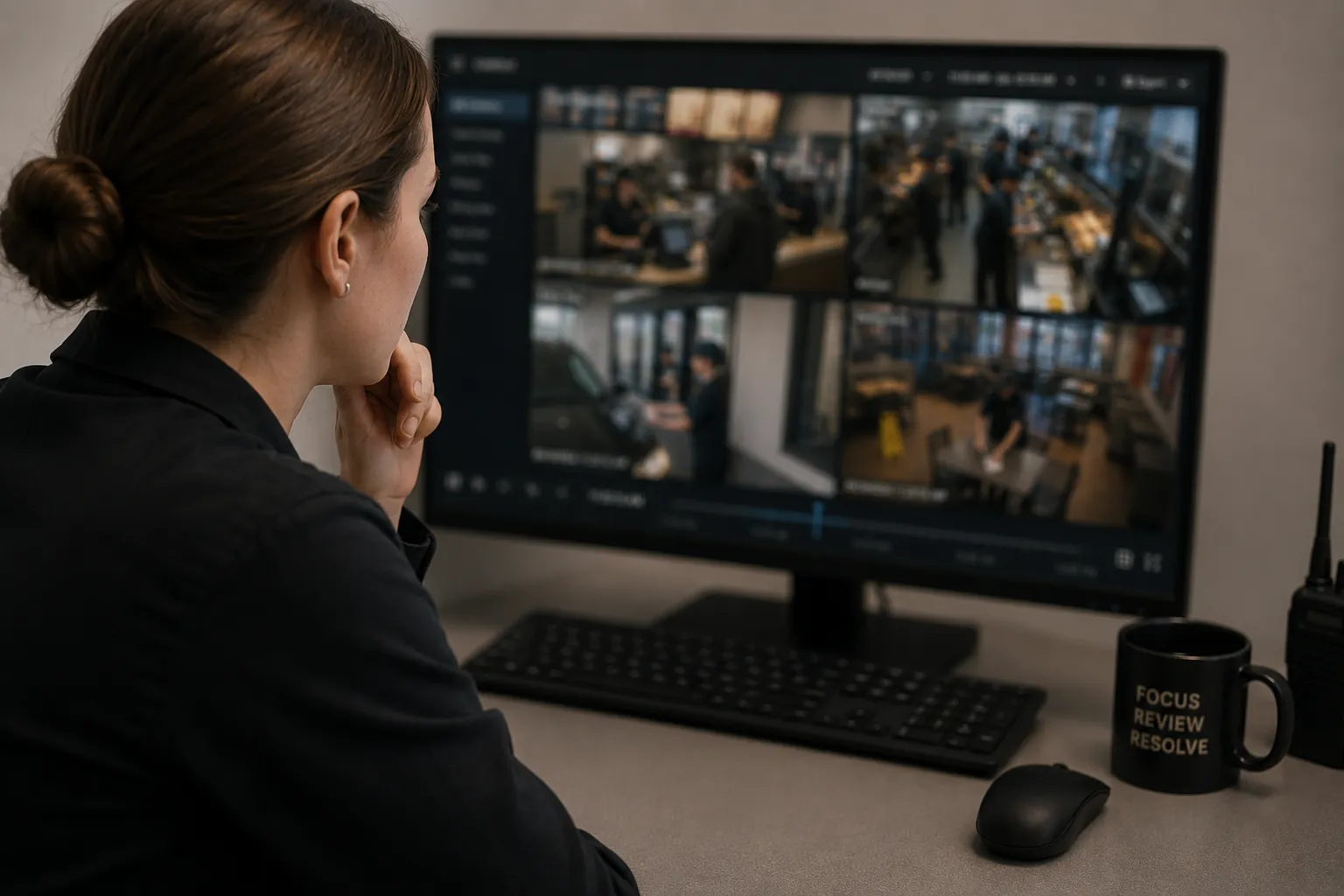
Why Video Evidence Only Works When Someone Reviews It
Loss prevention video evidence is only as useful as the human reviewing it. Most multi-unit operators have cameras in every location, and most have some form of software flagging anomalies, but few recover any real revenue from their setup. The reason is not the cameras nor the software; it’s the gap between a feed of footage and an actual finding the operator can act on. Closing that gap takes someone who knows what they are looking at, and who is paid to look at it every day.
Where video evidence pays back in loss prevention
Operators reach for footage when something has financial or legal stakes attached. The use cases that pay back the cost of your loss prevention monitoring investment include:
- Internal theft investigations, where footage and POS data are read together to build pattern evidence rather than chase single incidents
- Fraudulent refunds, where a returned receipt does not always match a returned item
- Chargeback disputes, where the operator needs proof to reclaim revenue the bank would otherwise write off
- Insurance and injury claims, where the exact moment of an incident is the difference between a paid claim and a denied one
- Cash shortage investigations, where a register imbalance could be theft or a handling error, and the receipt tape alone doesn’t tell you which
Retailers reported a combined 19% increase in external shoplifting and merchandise theft incidents from 2023 to 2024 in the latest National Retail Federation report on retail theft and violence, following a 26% increase the year before. Quick service restaurants (QSRs) often run higher than general retail, typically because transaction volume is denser and supervision is thinner.
The limits of software-led loss prevention
Software is good at flagging anomalies, but it is limited at deciding the underlying meaning behind them. In the same NRF survey, only 2% of retailers had AI-based suspicious-behavior video detection fully operational, with another 11% saying they’d researched it and chosen not to implement.
A modern POS-integrated AI tool might surface a hundred transactions in a shift that look suspicious, but many of those will not be theft. Some will be retraining issues, others will be a manager being generous with a regular, and a handful will be something more concerning. The software can’t tell you which is which on its own, and treating every flag as a finding will erode your operator trust quickly. Cameras and AI on their own run into the same problem: footage without review is just storage.
The other reason software alone falls short is that the legal risk runs in both directions. Autonomous AI matching has been pulled into court repeatedly when the match was wrong. The Detroit Police Department settled with Robert Williams in 2024 over a wrongful facial-recognition arrest, the first publicly documented case but not the last, and states are now writing guardrails into law that require human verification before action. The same principle applies in commercial loss prevention, where a finding that turns into an accusation has to be defensible, and not just an algorithmic flag on its own.
What the software missed, an analyst caught: a 3% recovery
A multi-unit QSR operator we work with had been running a software-led setup for close to two years. The software was flagging transactions, the reports were landing in the right inboxes, and the revenue picture on the dashboards looked clean.
But when our analysts started reviewing footage against POS data across the network, they spotted something the software hadn’t. Employees were ringing in low-cost items at the register, when the actual purchase was a higher cost beverage. The unit price difference looked trivial per transaction, but when the pattern repeated, it became substantial.
Beverage carries the highest margin in the QSR mix, so the impact compounds. Once the under-ringing was corrected, recorded beverage revenue across the network rose by 3%, which represented money the dashboards had been showing as absent product, now showing as sales. A human analyst spotted it because they identified the consistent pattern and that is the kind of work the software is not built to do.
Want to see what an analyst catches in your network?
Contact us to learn more and for a free trial of our loss prevention services with the first month on us.
Why most restaurant loss starts as carelessness, not theft
The majority of video footage flags are not malicious; they’re instances of carelessness, but the real risk is when this carelessness becomes ingrained in culture.
A free drink for a regular is not theft. A bigger portion for the customer who waited too long is not theft. A miskeyed transaction is not theft. But if you treat every incident as one, you’ll lose your operators’ trust quickly.
What matters more is the pattern recognition. If one store has five of these incidents in a week, but the combined remaining sites have only two, something is likely happening at that store. The behavior may be entirely well-intentioned or it may be the early signal of a drifting culture. Internal theft tends to start with one person and spread through a team. This is monitoring, not auditing. Monitoring is continuous and pattern-aware, but an audit is a snapshot. Snapshots miss drift. Identifying and catching culture drifts before they normalize is the difference between a finding now and a potential write-off in twelve months.
Evidence, not accusation: what happens when our analysts find something
Not every flagged pattern is theft, and not every response is the same. Documented incidents are delivered to the operator as a finding, with timestamps, footage clips, and POS records together in a single report, and the operator decides what to do with it: for example, retraining, a conversation, formal action, or in some cases nothing more than a note flagged to continue monitoring.
This provides an operator with rich evidence, but not an accusation nor a recommendation to take disciplinary action against anyone. This distinction matters because it puts the operator in a strong position to act with confidence based on documentation. Beyond providing evidence, our analysts work with operators to plan and prepare any response.
Find the revenue your loss prevention setup misses
Many QSR operators lack an effective loss prevention system. They have cameras and software, but often lack an experienced analyst reviewing footage with the operator’s bottom line in mind.
If that gap is costing you revenue you can’t see, contact us for a free trial of our loss prevention services. The first month is on us, and the findings will not be hypothetical. You can also read more about how our analysts work by viewing our Loss Prevention Service.
Frequently asked questions
Why isn’t video evidence alone enough for loss prevention?
Footage shows what happened, but it does not interpret what it means. A camera will record a void, a refund, or a free drink, but only a trained reviewer can tell whether that void is theft, a generous regular, or a register error. Loss prevention video evidence becomes useful when an analyst cross-references footage against POS data and tracks patterns across the network, not single incidents.
Can AI replace a human loss prevention analyst?
AI in loss prevention is good at flagging anomalies and weaker at interpreting them. Most flagged transactions are not theft, and treating every flag as a finding burns operator trust quickly. A human analyst reads context, weighs a pattern against a single incident, and produces evidence the operator can act on with confidence.
What does the Pembroke loss prevention service include?
Our analysts review footage against POS data every day across the network. We build findings that include timestamps, footage clips, and the matching transaction records. The operator decides on the response, whether that is retraining, a conversation, or formal action. Findings are documented evidence, not accusations.