Pay Transparency Laws in 2026: What All Businesses Need to Know
If your last job posting did not include a salary range, and the role can be performed in California, Massachusetts, or one of thirteen other states, you may already be out of compliance. Pay transparency laws are now active in fifteen states plus the District of Columbia, with Delaware joining in September 2027.
Enforcement caught up in 2026 too. Massachusetts and New Jersey are issuing penalties against non-compliant postings, and California’s stricter definition of what a ‘good-faith’ salary range can be took effect in January. For multi-location operators hiring across state lines, every posting and every hiring record now sits on the front line of compliance, and the rules are not the same in any two states.
This guide walks you through what the laws actually require, which states they apply in, where multi-location operators can get caught out, and where outside consulting and compliance work earns its place, so you can spot the gaps before a state notice arrives.
The five rules that show up in every pay transparency law
Sometimes called wage transparency laws or salary disclosure rules, pay transparency laws require employers to disclose a good-faith pay range in job postings, and increasingly to back that disclosure with documentation that proves the range was set fairly.
The specifics shift state-to-state, but five requirements appear consistently:
- Salary range disclosure. The posted range must reflect what the employer reasonably expects to pay: not a placeholder figure. California tightened this definition in January 2026, removing the option to publish an overly broad range as a workaround.
- Benefits description. Illinois, Minnesota, and New Jersey all require employers to include a general description of benefits alongside the pay range.
- Salary history bans. Many states prohibit employers from asking candidates about their previous pay, regardless of whether the same state also requires posting disclosure.
- Record retention. Delaware’s 2027 law requires employers to keep wage and job description records for at least three years after employment ends. Other states have introduced similar duration rules of their own.
- No open-ended ranges. New Jersey and Minnesota explicitly forbid vague phrases like “up to $80,000” or “$50,000 and up.” New Jersey adds a spread cap on top as well where the maximum salary cannot exceed the minimum by more than 60%.
The 2026 state map: where pay transparency laws apply
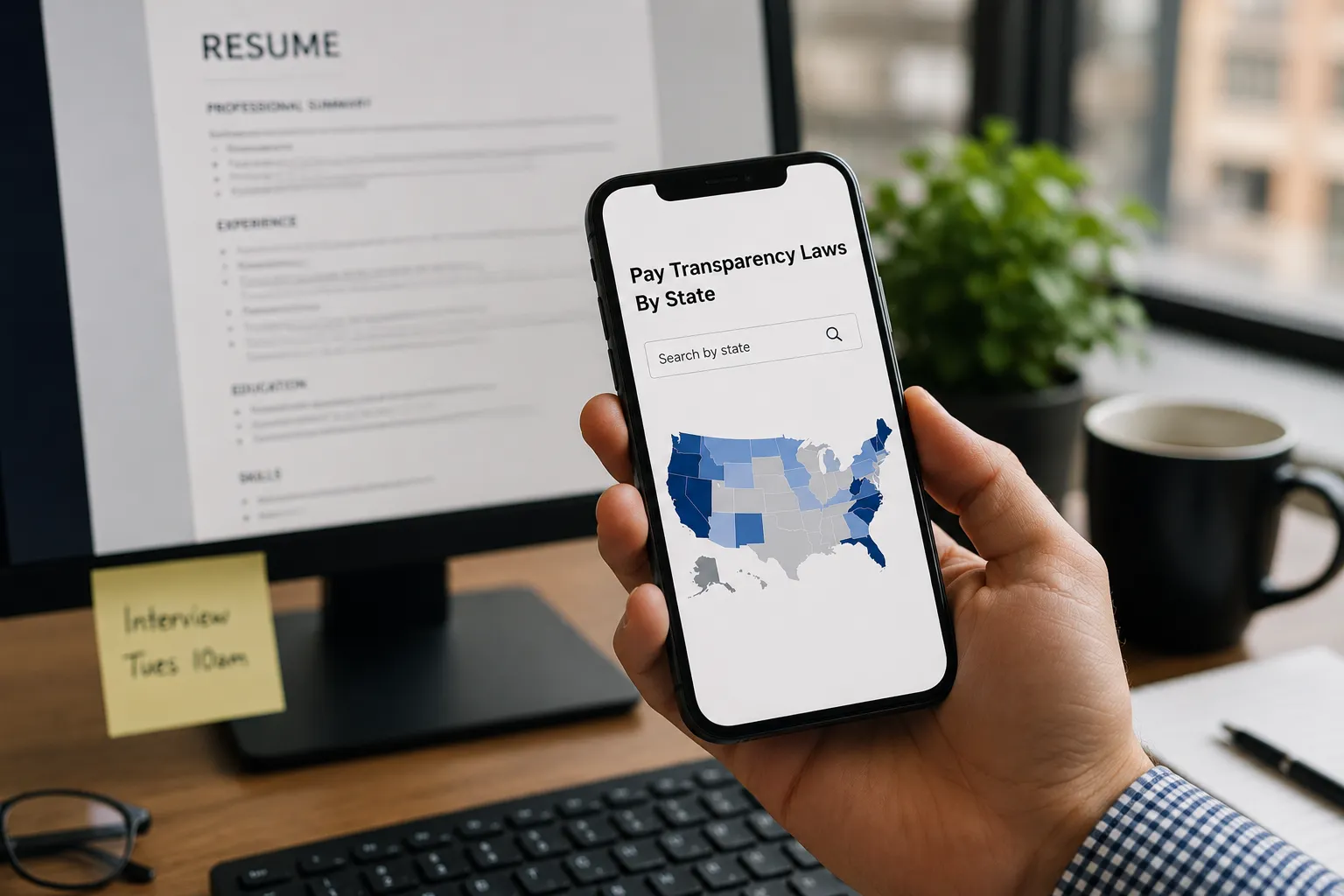
Pay transparency laws by state fall into three groups in 2026.
The strictest group is the in-posting disclosure states, where every job listing must include a salary range. California, Colorado, Hawaii, Illinois, Maryland, Massachusetts, Minnesota, New Jersey, New York, Vermont, and Washington all sit here, with the District of Columbia operating the same way. Employee-count thresholds vary: California and Washington apply to employers with 15 or more employees, Massachusetts to 25, Minnesota to 30, and New Jersey to 10.
The second group requires disclosure on request or at specific points in the hiring process, rather than in the posting itself. Connecticut, Nevada, and Rhode Island operate this way. The obligation is still there; it just kicks in once a candidate asks or reaches a defined stage in the recruitment process.
The third group is what’s coming next. Delaware’s law takes effect in September 2027 for employers with more than 25 employees. Maine’s law came into effect this year. Washington amended its rules in 2025 to give employers a five-business-day grace period to correct non-compliant postings after receiving notice.
Across all three groups, one rule catches operators out more than any other: the disclosure obligation follows the role, not the office. If a remote position can be performed from a pay transparency state, that state’s rules apply, even when the employer is headquartered somewhere with no disclosure law at all. For multi-location operators, that is where the picture starts to change.
How multi-location hiring multiplies pay transparency risk
Compliance is hard enough in one state. In three, it stops being about following one rule and starts being about reconciling several at once, often on the same posting, with different thresholds and different tests for what counts as compliant.
Here are the three patterns that explain how multi-location hiring can catch operators out, and what you can do about each one.
How one job posting template can break three state laws
A single-location operator works against one state’s rules. A multi-location operator hiring across California, Illinois, and New Jersey works against three at once, each with different thresholds, range definitions, and posting requirements. Each new state brings its own documentation requirements, separate salary history rules, and, in California’s case, a tightened definition of what counts as a good-faith range. A template that worked in 2024 can now miss the mark in three places at once, and operators may not realize until the first state notice arrives.
This is where outside consulting and compliance support earns its place. Pembroke & Co.’s operational consulting work keeps job postings, policies, and hiring records aligned with state laws so multi-state complexity stops being something the operator has to track personally.
Why a remote role triggers compliance in every state it touches
Remote and hybrid roles often surprise businesses most. Whether a state’s disclosure rule applies depends on where the work can be done, not where the company or the branch is based. A district manager job posted as remote and open to candidates in California, Massachusetts, and Washington picks up three sets of disclosure obligations on a single listing. Field, support, and corporate roles have the same requirements whenever a listing is open across state lines. Many operator hiring templates haven’t been updated for this yet, largely because the disclosure obligations didn’t exist before. A single compliant range and benefits description, sized to the strictest state in scope, takes most of the surprise out of it.
Where pay transparency gaps tend to open up
Most pay transparency gaps fall into four categories:
- Salary ranges missing from postings entirely, often where one location is still using an older job posting template that was never updated.
- Ranges too broad to count as good faith under California’s 2026 amendment, or wider than New Jersey’s 60% maximum spread.
- Benefits description left off where the state requires it.
- Internal promotion notices and pay-related record-keeping behind state requirements, particularly where Colorado’s promotional notice rules apply.
The first two are typically caught when operators review their own postings. The third and fourth surface during state-initiated checks rather than candidate complaints, which is why operators do not always see them coming.
Closing the pay transparency gap with your operational partner
Enforcement started in 2026, and the cost of being late on pay transparency is no longer hypothetical. A multi-location hiring strategy that worked last year will not survive an active state review this year.
Multi-location operators bring Pembroke in as an embedded operational partner. We help operators cover job posting writing that builds compliant ranges and benefits descriptions, policy creation that keeps pay frameworks and documentation current with each new state law update, and hiring records maintained to the standard each state requires.
Book a complimentary consultation to assess where you stand.
Frequently asked questions
Which states require salary ranges in job postings?
As of 2026, fifteen states plus the District of Columbia require employers to include salary ranges in job postings or disclose ranges on request. In-posting disclosure states include California, Colorado, Hawaii, Illinois, Maryland, Massachusetts, Minnesota, New Jersey, New York, Vermont, and Washington. Connecticut, Nevada, and Rhode Island require disclosure on request or at specific points in the hiring process. Maine joined the in-posting group during 2026, and Delaware follows in September 2027.
How do pay transparency laws apply to remote workers?
The compliance trigger is where the role can be performed, not where the employer is headquartered. A remote or hybrid role open to candidates in pay transparency states carries those states’ disclosure obligations on the same posting, regardless of the employer’s location. A remote listing open across California, Massachusetts, and Washington pulls in three separate sets of rules at once. Most multi-location operators have not adjusted their remote posting templates for this.
How can businesses stay compliant with pay transparency laws?
Three priorities matter most. First, build compliant pay ranges and benefits descriptions into job posting templates by default, sized to the strictest state in scope. Second, keep hiring records and pay documentation current with state requirements, particularly the three-year retention rule taking effect in Delaware in September 2027. Third, assign clear ownership for tracking state-level changes, either internally or through an outside consulting partner with multi-state visibility.